What the Ockenden Report Teaches Us About Assurance

Rowland Agidee
Chief Data, Analytics and AI Officer - NHS, and Data Observatory Council Senior Advisor
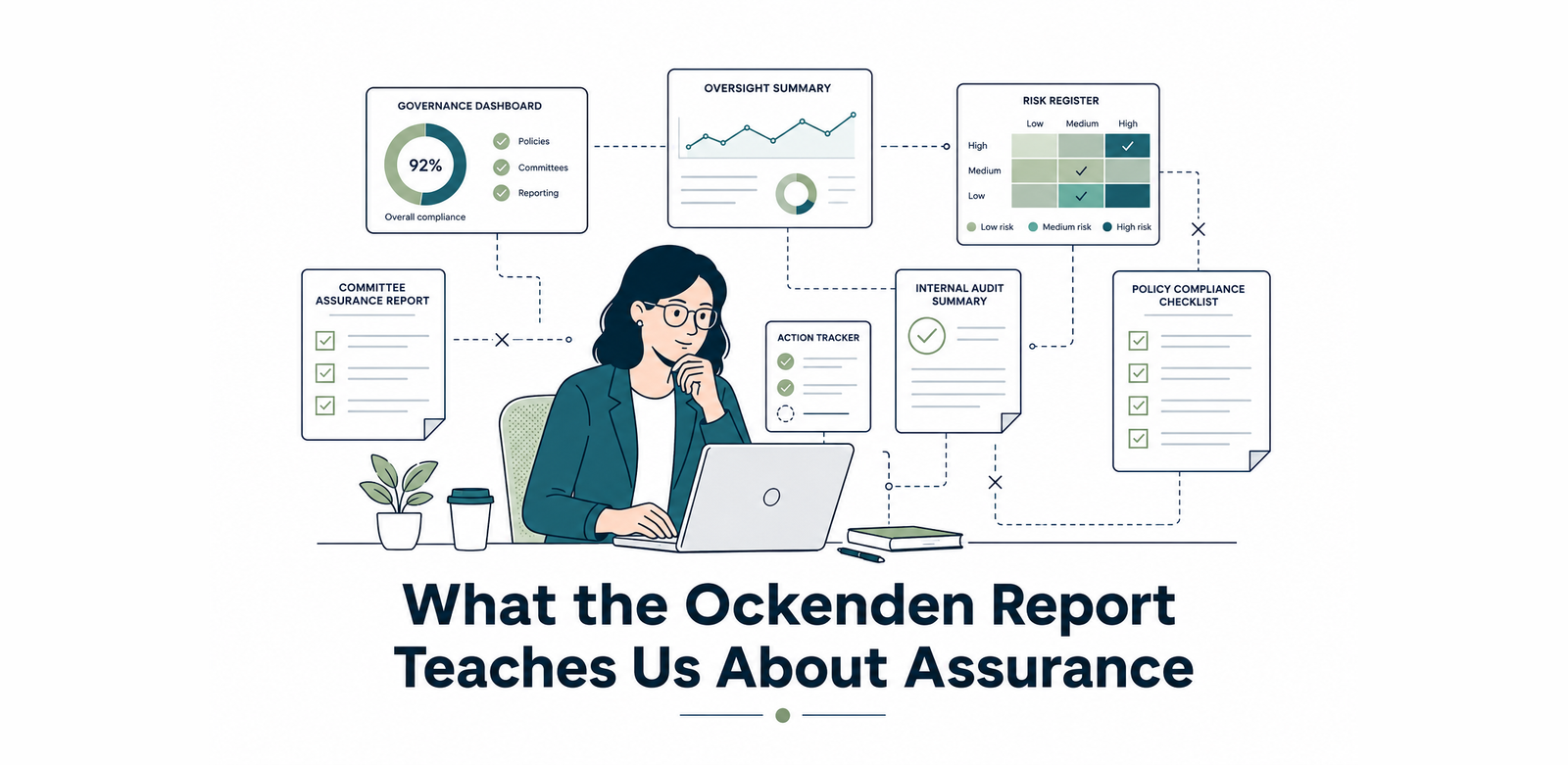
On 24 June 2026, Donna Ockenden published her independent review into maternity services at Nottingham University Hospitals NHS Trust — a 401-page account drawing on the experiences of more than 2,500 families, covering care between 2012 and 2025. It is, among everything else it is, one of the clearest public demonstrations I have seen of a structural failure that has nothing to do with maternity care specifically and everything to do with how organisations assure themselves that things are working. I want to use it here to introduce a framework I've developed over several years of NHS data and digital leadership — the Digital Transformation Resilience Model (DTRM) — and two of its core constructs: the gap between implementation and integration assurance, and the leadership dynamics that quietly produce it.
"Governance structures existed in form but not in function."
That sentence, drawn from the report's account of a 2021 internal governance review, does more analytical work than most consultancy decks I've read. It says: the structures existed. Committees met. Dashboards were populated. Action plans were written and approved. And none of it functioned as a connected system. The rest of this piece explains why that gap — between form and function — is not a one-off failure, but a structural pattern that recurs across the public sector, and what a different way of looking at assurance can do about it.
Most organisations are good at proving that something happened. A policy was approved. A system went live. A programme hit its milestones. This is implementation assurance, and it absolutely matters — without disciplined delivery, strategy is just theatre.
But implementation is not the same as integration. Integration assurance asks a harder question: did the thing that was implemented actually become part of how the organisation works? Is the new policy embedded, or just filed? Did the system replace the old workaround, or sit alongside it? Did the programme change behaviour, or just produce a green RAG status?
Implementation tells us that something happened. Integration tells us whether it mattered.
The Ockenden Report gives us an almost laboratory-clean test of this distinction. Between 2015 and 2022, NUH was the subject of at least six external maternity reviews — some commissioned by the Trust itself, in response to internal or escalating concerns; others commissioned by oversight bodies, including NHS England and the local Clinical Commissioning Group, once those concerns reached them. Each review identified substantially the same problems: under-reporting of incidents, inconsistent grading of harm, weak escalation routes, insufficient Board visibility. Each one produced recommendations. The report's own conclusion is that there is limited evidence those recommendations were systematically carried through from one review into the next.
Six rounds of review. The report's findings suggest none of them fully integrated. The same structural gap kept reopening because nothing in the system was built to close it permanently — and because no single body held a continuous, structural view of what had already been tried, what had failed, and why.
It would be easy to stop at "poor leadership" or "weak culture" as the explanation, and much of the commentary on this report has done exactly that. I think it's worth going one layer deeper, because the report's own evidence points to something more structural and, frankly, more forgivable: leadership behaviour in transformation and governance contexts is not simply expressed — it is selected.
DTRM calls this Leadership Selection Effect (LSE): the process by which performance regimes, accountability architectures, and politically visible delivery signals systematically favour particular leadership behaviours over others, over time, regardless of the individual qualities of the people involved.
Two behavioural clusters sit either side of this effect. Spike leadership is short-horizon, delivery-optimising behaviour — directive, responsive to crisis, focused on producing the next visible milestone. Architect leadership is longer-horizon, system-design behaviour — focused on whether the institution as a whole is becoming more coherent, and willing to accept slower or less visible progress in service of that. Neither is good or bad in itself; most functioning organisations need both. The problem is what happens when oversight environments — boards, regulators, central bodies — reward visible delivery signals (milestones, RAG status, completed reviews) so consistently that Spike behaviour becomes the only behaviour that gets selected, resourced, and promoted, displacing the Architect-level work that integration actually requires.
Leaders who can reliably produce visible delivery signals accumulate legitimacy. Leaders who surface integration complexity can be perceived as creating uncertainty — even when they are improving diagnostic accuracy.
This is precisely the pattern the Ockenden Report documents, without naming it as such. A 2021 review found senior leaders "unaware of the extent of governance failings" in their own maternity service, describing "a loss of line of sight from ward to Board." Midwifery leaders did not have direct Board access at all — producing, in the report's words, "a disconnect between strategic direction and operational management." Six successive reviews each produced their own implementation artefacts — reports, action plans, committee structures. What was structurally absent was an assurance regime, and the leadership incentives to sustain one, oriented to verifying whether any of it had actually been absorbed into how the organisation worked.
This is also why culture is usually the wrong place to stop the analysis, even though it's where most commentary on reports like this one lands. Culture is real and it matters — but in this account it reads as downstream of structure, not the root cause of it. Missing information channels and absent lines of sight create the conditions in which a defensive or closed culture takes root and is then very hard to dislodge. Fix the channel, and you change what the culture has to defend against.
I want to be precise about what this piece is and isn't. It isn't a commentary on the individuals who led Nottingham University Hospitals through an extraordinarily difficult period, several of whom inherited problems that predated their own tenure by years, and who were themselves operating inside the same selection effects described above. NUH is a neighbouring Trust to my own organisation, its staff are colleagues across the same system, and the families at the centre of the report deserve a response built on care rather than spectacle. What the report offers everyone else is rarer than criticism: a fully evidenced, independently verified account of what happens when implementation assurance runs ahead of integration assurance for long enough, sustained by leadership incentives that no individual board member necessarily chose or noticed.
Every board reading this will recognise something in it — a committee that receives information too granular to assure and too thin to manage, a frontline team whose concerns travel through three layers before reaching anyone able to act on them, a dashboard that's green because the metric it tracks isn't the thing that's actually breaking.
A few questions worth asking before the next report rather than after it:
No board needs a national inquiry to start asking these questions. The Ockenden Report simply removes any excuse for not asking them now.
Rowland Agidee is Chief Data, Analytics and AI Officer in the NHS and the developer of the Digital Transformation Resilience Model (DTRM), a framework for diagnosing structural risk in large-scale digital and organisational change. He writes and advises on data governance, assurance architecture, and the gap between implementation and integration in complex public sector systems.
We convene leading experts and scientists across health and social care to explore the ideas shaping the future of data.
Interested in partnering or collaborating on a topic? We would love to hear from you.