The Stability and Future of the NHS

Dr Huw Davies
Chief Operating Officer

By Dr Huw Davies, Chief Operating Officer at Data Observatory CIC
"The NHS is an organisation that provides healthcare to everyone in the UK that is free at the point of access" stands as a proposition. You can argue whether it is true or false. The fact that it is "good" is a value statement which requires substantiation (though some would argue such activities are good in themselves). To ask whether it is fit for purpose, begs the question of "what purpose"?
When the dulcet Welsh tones of Nye Bevan (well, they were when uttered by Michael Sheen in the stage production of "Nye") described the health service, it is unlikely that he had considered the success of the NHS. The NHS is not failing, it has overachieved. The lifespan for the average woman in the UK has increased by 10 years (KingsFund.org.uk) over the course of my lifespan. An indicator of the success of the NHS surely?
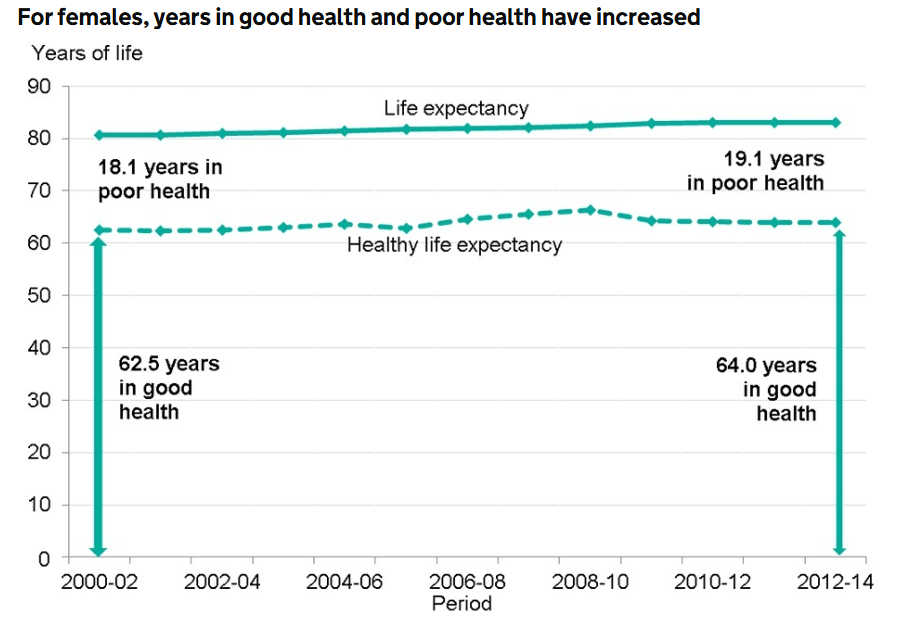 Source gov.uk
So let's change things around…
For the love of all that is sacred please no! Whether you are big government or small, left or right, social or industrial, the NHS is not a political football, there to be kicked around because you fancy putting in some changes to suit your political agenda. That said, it is a public body and needs to be accountable to the people who, believe it or not, are represented by their respective members of parliament. (I don't think Joseph Heller could have written a more accurate depiction of the situation.)
The NHS is a highly sensitive organism that responds in ways that the most lateral of systems thinkers would raise an eyebrow to. Every care pathway in the country will be influenced by differing factors. Every ailment presentation will be, to some degree, unique. How can we possibly factor for that whilst contemplating the inevitable fact that older people require healthcare more often?
We could discuss the specificity of the outcomes of a near infinite number of organisational challenges until we require intubation. This will not solve the problem. Let us, instead, imagine we are in a position to change things. What might we conjecture as being a potential solution?
OK, ground rules – we are where we are and we've got what we've got. No magic wand, no time machine.
ICBs are being instructed to commission world-class public population health strategic management (I may have conflated a little there). But the push to strategic commissioning, as a subtle but irritatingly necessary distinction to population health management, is in progress. The pending Strategic Commissioning Development Programme is preparing to press the button on a £10million contract to deliver this development. Brilliant, but ICBs need support from the centre. Ongoing support. Support that lasts longer than a 2-year procurement. Administrative support: analysis, accounting, facility management, contract management, legal services, HR. All go way beyond the services that a now small ICB can resource itself. All without the behemoths of NHSE and CSUs. But let's put that practicality to one side for now.
Let's take strategic commissioning at face value. Commissioning services to enable for the population to live better for longer, in the ever-insightful words of Professor Sir Muir Gray. To engage in services to help the population manage their health. For the purposes of this conjecture, let's just pick some of the old public health issues of smoking cessation, weight management, sexual health. By all but irradicating these issues, we may shift the dial from 3 out of 10 years in good health, to 6 out of 10. Environmental factors, social deprivation, cultural norms etc. may well bring the figure close to 100%, thus enabling the NHS to continue and to be funded proportionally to the size of the population (there is no doubt that even a healthy person falls off a ladder from time to time (ahem).
So how does one do this? How do you shift a culture of spending on treatment activity, to spending for the lack of needing to treat? Acute providers get paid for their activity. To change that for a system that takes at least five years to reap its benefits would be to necessitate a doubling of cost. I don't think the treasury will go for that idea.
The trick has to come from what we call commissioning. We have to understand that as part of such a complex organisation, dealing with such delicately connected issues that population health does, so commissioning is going to need to be done with great specificity. The ICBs didn't have the resource to do this before their reduction in size, let alone now. But they are the curators of their regions. Each ICB will have the full range of demographic, this is something they all have in common, but they will have that range with vastly different weightings and those weightings will vary from place to place and neighbourhood to neighbourhood. You can't expect them to be responsible for creating a multi-agency drop-in-centre over 100 neighbourhoods, each one bespoke to the needs of the area.
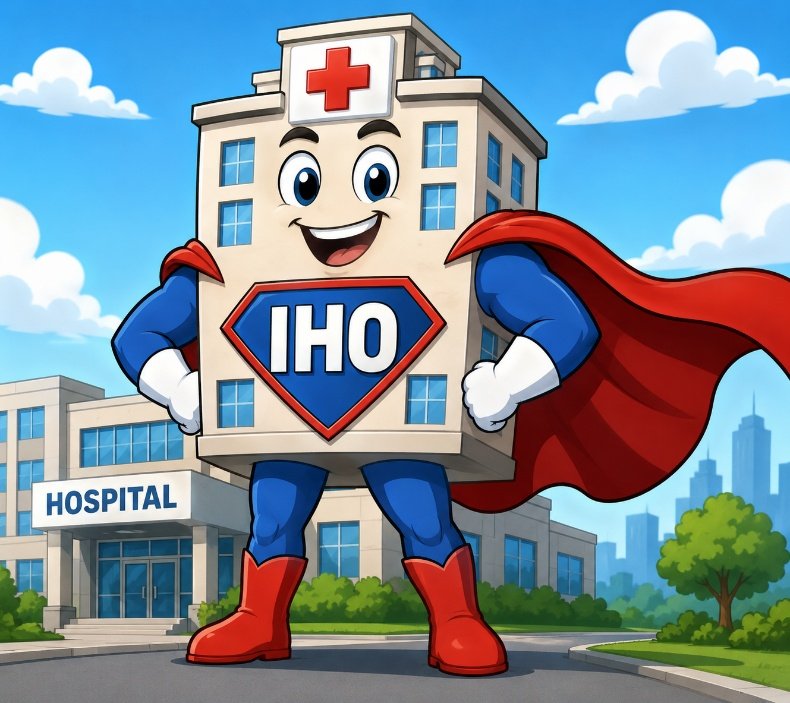
The requirements of the population within an ICB needs to be clearly mapped with areas of concern identified and explicated to the IHO. But apart from this, the services of an IHO should be commissioned by a light touch; a list of guidelines (or stronger if required) that an IHO can adapt to meet the needs of locality, neighbourhood, and place. Strategic commissioning from an ICB should focus on value based outcomes, those things that matter, socially as well as economically, and they should be commissioned to IHO with a guidebook of light touch principles (some of which may be hard and fast rules) that the IHO can subsequently go out to other providing partners and collaborate, subcommission, or even co-commission other services.
 The main difficulty is how these services can be commissioned. A hospital can't just cut services, can they?
Well, no, and nor should they. There is a strong argument for the more explicit decommissioning of services (which should always have been happening but never seems to have) as made by the ever-astute Andi Orlowski in the HSL (May 2026). It is clear that some activity needs to be cut as ineffective healthcare. What those services are will vary and only the clinicians in those localities will know, but that fits with the model. Simply as part of the light-touch commissioning process, a medium-term 5-year funding model should be agreed which gradually increases the allocation of funds to value-based outcomes, and reduces funding for reactive care. This will allow the IHOs to implement change at a pace which meets the needs of the public whilst not requiring double funding and without leaving a black hole (maybe Super Trust isn't so facetious after all).
The main difficulty is how these services can be commissioned. A hospital can't just cut services, can they?
Well, no, and nor should they. There is a strong argument for the more explicit decommissioning of services (which should always have been happening but never seems to have) as made by the ever-astute Andi Orlowski in the HSL (May 2026). It is clear that some activity needs to be cut as ineffective healthcare. What those services are will vary and only the clinicians in those localities will know, but that fits with the model. Simply as part of the light-touch commissioning process, a medium-term 5-year funding model should be agreed which gradually increases the allocation of funds to value-based outcomes, and reduces funding for reactive care. This will allow the IHOs to implement change at a pace which meets the needs of the public whilst not requiring double funding and without leaving a black hole (maybe Super Trust isn't so facetious after all).
A huge amount of support will be required to set this up and to enable it to continue to develop. Thank goodness for the centre… oh…
 ICBs will hopefully be given the knowledge to be able to delivery what is required through the Strategic Commissioning Deployment Programme, with specific reference to the delivery programme currently being procured. NHSE said they need a consortium that understands analytics, commissioning, PHM, and finance. From this angle, it looks like they need a shed load of vision too, along with the influencing power to push back to a waning NHSE and upward into DHSC. Someone unafraid to speak truth to power.
I suppose all of this is just a best world outcome of the government's slashing of the centre even if being conducted by talented people using little more than educated guesswork. But aside from describing how what is happening should happen, there is nothing completely novel here, and I think that is why it falls down as we currently see it. The government, when questioned about the lack of capacity at the centre to deliver a programme within days of the cuts being made, simply suggested, "well they will have to use consultancies then". What sort of consultancy Mr Minister? One of the ones who only ever deliver their own model of delivery as their vast profits lie in promising novelty but delivering replication, or maybe one of the ones who put some real market leaders on the bid and factor them into the cost, only to leave graduates in the delivery team, unable to bequeath any knowledge to NHS staff, or perhaps the one who just undercuts the rest based on no real knowledge of the NHS and leaves half way through, unable to deal with the organisational complexity or even human compassion of telling commissioners how to commission after you've just sacked-off half of their friends, or one of those consultancies that are more common and all of the above?
No, there has to be a better way.
The stretch on NHS services made by the ever-increasing gulf between life expectancy and healthy life expectancy is existential. If we don't get it right this time, the odds on a catastrophic event lay all on the house.
There might be a solution.
We have a shot that not only offers a short-term fix, but also reduce the cyclical requirement to throw everything out with the bathwater.
The clues were given by the former Secretary of State when he said that they are looking to make the NHS answerable to the people. [sigh] Now, forgetting the million and one things I have to say about that, there is something to say here about the fact that it is proper that the population has its say, though I doubt they would recommend the five-yearly slash and burn of recent years. But there needs to be consistency that is unaffected by direct government mandate.
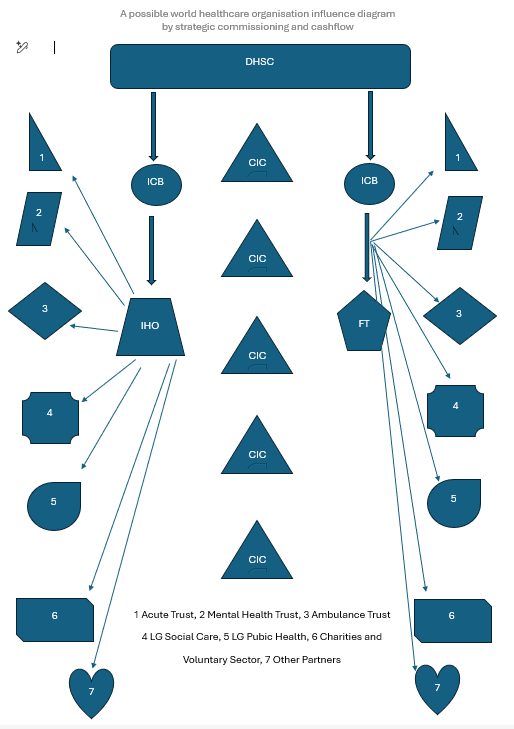
The data observatory is independent of government so free from the direct cyclical changes, we are not-for-profit so the costs are as low as possible, we are made up of some of the country's most accomplished and respected health and social care talent, available to support ICBs when needed and without obligation, available to support all other aspects of health and care, our only motivation is the promotion of health outcomes for the country.
We can support an ICB while their providers mature into IHOs. We can support IHOs in complex, niche, or national analytics that are beyond their economies of scale. We can produce thought leadership to increase the efficacy of the data profession. We sponsor and support individuals and professional bodies in increasing standards. We can be engaged in everything from a single analysis to regional redesign.
We can do all of this, without fear of government, without political bias, no matter how uncomfortable the truth, focussed only on public good.
But this isn't an advert for the Data Observatory, for me, the DO sells itself. It is a call to arms. If we can do this for the data profession, can the central functions that have been cut from the centre elsewhere also be a CIC. HR, Procurement, IT. Let the system be truly democratised by allowing all the organisations in health and social care to choose their support function. The beauty of, and I'll say NHS for shorthand, is that people love the NHS and want to work there as a result. The Data Observatory is not interested in consultancy fees of up to ten times the cost of substantive staff to do the same thing. Why can't the HR Observatory, or the Training Observatory, or the Procurement Observatory all be present to do the same thing.
There were 18,000 working in NHSE alone. I'd be very surprised if 10% of these fitted the profile of a stereotypical bureaucrat. They were all doing a job of work that still needs to be done. Sure, it may need to be done more efficiently, but it still needs to be done.
The Data Observatory exists for using data for social good. The Observatory model may just also help save the NHS and help shape it to deal with the outcomes of its own success.
We convene leading experts and scientists across health and social care to explore the ideas shaping the future of data.
Interested in partnering or collaborating on a topic? We would love to hear from you.