Building the Digital, Data and Analytical Workforce the NHS Needs

Neil Morgan
Chief Analytics Officer, NHS MLCSU and Vice Chair of Data Observatory Council
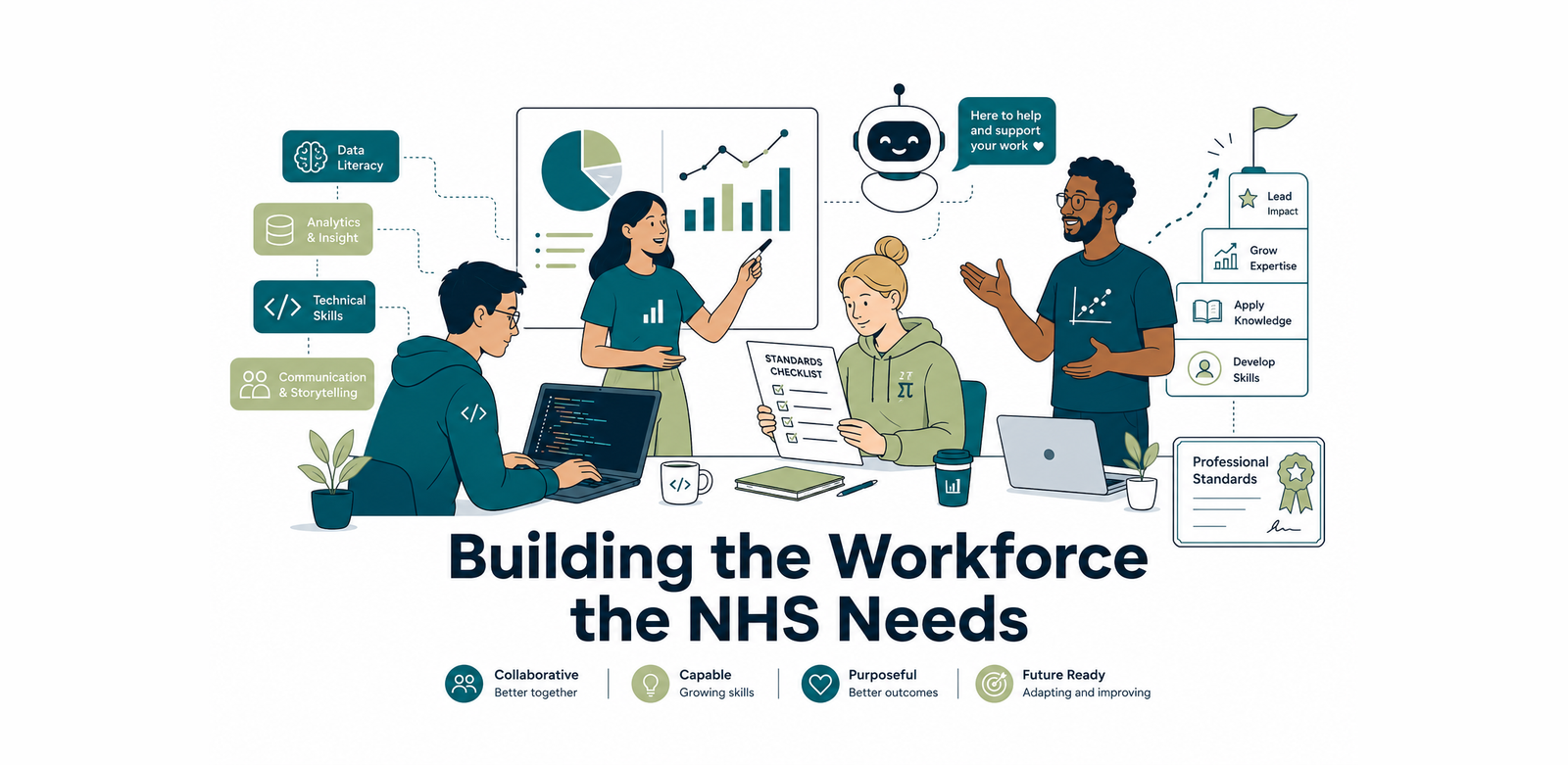
As NHS England prepares to publish its revised workforce strategy, the delivery of the 10-Year Plan will depend heavily on the strength, capability and sustainability of the digital, data and analytical workforce. These professions sit at the heart of the NHS's ambitions to improve productivity, accelerate innovation, expand community care and realise the potential of transformative technologies such as artificial intelligence.
However, the NHS faces a complex combination of workforce pressures, skills shortages and organisational change at precisely the moment when demand for digital and analytical expertise is increasing. The challenge for NHS leaders will be to balance immediate capacity constraints with longer term workforce transformation.
The NHS has invested significantly in digital transformation over recent years, yet the workforce responsible for delivering and sustaining these capabilities remains under considerable pressure.
A particular concern is the reduction in analytical capacity across NHS England. A fact highlighted in the recent Health and Social Care Select Committee (16th June). Estimates suggest that voluntary redundancy programmes, combined with existing vacancies, could reduce parts of the national analytical workforce by almost half compared with full establishment levels. Such reductions risk creating capability gaps in areas that are central to the success of the 10-Year Plan, including population health management, clinical safety and data quality improvement.
These pressures arrive at a time when the NHS is increasingly dependent on data-driven decision making. Without sufficient analytical and technical capacity, there is a risk that national data assets, reporting platforms and digital services become more difficult to maintain, develop and improve. This could undermine confidence among clinicians, managers, patients and the public who increasingly rely on these services.
The workforce challenge is not simply one of numbers. Across many digital and analytical teams there are longstanding concerns about workload, burnout and retention.
Staff are frequently required to deliver major transformation programmes while simultaneously maintaining critical operational services. In this environment, retaining experienced professionals and creating attractive career pathways becomes increasingly important.
The emerging workforce strategy recognises that the NHS cannot meet future demand through recruitment alone. Competition for digital, data and AI specialists is intense, with both the private sector and other public sector organisations competing for the same talent pools.
As a result, the focus is shifting towards creating a smaller but more productive workforce, supported by modern technology, improved professional development and clearer career structures.
AI is expected to play a significant role in this transformation. Rather than replacing staff, the ambition is for AI to become a trusted assistant that automates routine administrative activity, supports clinical decision-making and reduces time spent on repetitive tasks. Technologies such as ambient voice systems, AI-powered documentation tools and intelligent workflow automation have the potential to release significant clinical and operational capacity. If implemented effectively, these technologies could allow staff to focus on higher-value activities while improving both productivity and job satisfaction.
One of the most significant developments within the workforce agenda is the growing recognition of Digital, Data and Technology (DDaT) professionals as a distinct and critical NHS workforce group.
Historically, digital and analytical professionals have lacked the professional recognition afforded to clinicians and other regulated healthcare professions. This has often resulted in inconsistent career pathways, varying standards and limited opportunities for professional development.
The proposed introduction of professional membership and registration requirements for DDaT staff represents a major step forward.
The intention is to establish clearer standards of competence, ethics and continuous professional development across the profession, helping to build confidence in digital and analytical services as their role becomes increasingly central to patient care.
Current proposals suggest a phased implementation beginning with senior leaders in 2026/27 and gradually extending across the entire workforce by 2030. Alongside this, there is recognition that financial barriers must be addressed, with support mechanisms being considered to ensure professional registration remains accessible to staff at all levels.
Delivering the ambitions of the 10-Year Health Plan will require a fundamental shift in how workforce development is approached.
Traditional role-based training models may struggle to keep pace with rapidly evolving technologies. Instead, there is growing support for more flexible, modular and skills-based approaches that allow individuals to develop expertise aligned to specific tasks and capabilities.
For example, the implementation of AI-enabled clinical decision support may require expertise in data governance, prompt engineering, machine learning, information governance, clinical safety, data engineering, user-centred design and change management.
Rather than requiring every professional to retrain into a new specialist role, a modular skills-based approach enables individuals to acquire the specific competencies relevant to their existing profession. A clinical analyst might undertake training in AI model evaluation and assurance, a data engineer in deploying and monitoring machine learning pipelines, an information governance specialist in AI regulatory compliance, and a clinician in the safe interpretation and application of AI-generated recommendations. Together, these complementary skills create multidisciplinary teams capable of safely designing, deploying and embedding AI solutions into routine clinical practice.
This approach could help accelerate workforce deployment into emerging areas such as data science, AI assurance, digital product development and population health analytics. It also aligns with broader ambitions to provide personalised career development pathways and lifelong learning opportunities for NHS staff.
At the same time, the NHS must continue to address existing training bottlenecks. Expanding educational capacity, increasing apprenticeship opportunities and creating alternative entry routes into digital and analytical careers will be essential if the service is to build a sustainable talent pipeline.
The successful development of the NHS DDaT workforce will depend on strong collaboration between NHS organisations, professional bodies, academia and industry.
Professional organisations have an important role in defining standards, accrediting learning programmes and supporting continuous professional development. Professional registration frameworks provide assurance that individuals possess the skills and competencies required to operate safely in increasingly complex digital environments.
These partnerships are becoming even more important as AI technologies are adopted at scale. Ensuring that digital professionals have access to high-quality learning resources, communities of practice and recognised professional standards will be critical to maintaining public trust and ensuring safe implementation.
Professional networks also provide valuable channels through which practitioners can influence policy, share learning and shape the future direction of the profession.
The NHS stands at a pivotal moment in the evolution of its DDaT workforce. Delivering the ambitions of the 10-Year Plan will depend on a highly skilled, professionally recognised and sustainable workforce capable of driving transformation across health and care.
Although workforce reductions, recruitment challenges and skills shortages present significant risks, they also create an opportunity to modernise how DDaT professions are developed and deployed. Professionalisation, flexible career pathways, modular skills-based learning and the intelligent adoption of AI can together create a more capable, productive and resilient workforce.
Realising this opportunity requires greater collaboration across the DDaT professions. By bringing together the whole range of subject matter experts (analysts, data engineers, data scientists, developers, clinical informaticians, etc), the NHS can design, implement and embed end-to-end data and insight capabilities that are technically robust, operationally relevant and centred on improving patient outcomes. Aligning technical, analytical and domain expertise around shared objectives will accelerate the adoption of digital technologies, improve decision-making and reduce duplication, helping deliver more effective, personalised and preventative healthcare at lower cost.
The challenge for NHS leaders is therefore not simply to fill vacancies, but to create the conditions in which DDaT professionals can thrive, collaborate and lead.
This requires sustained investment in professional capability, recognised career pathways, multidisciplinary ways of working and a culture that values collaboration across professional boundaries. By doing so, the NHS can build a workforce capable of delivering sustainable transformation while maximising the return on its digital, data and technology investments.
We convene leading experts and scientists across health and social care to explore the ideas shaping the future of data.
Interested in partnering or collaborating on a topic? We would love to hear from you.